
The Application of the Cyanosis Observation Index (COI) in Healthcare Lighting
1. The Problem: What Healthcare Staff Cannot Afford to Miss
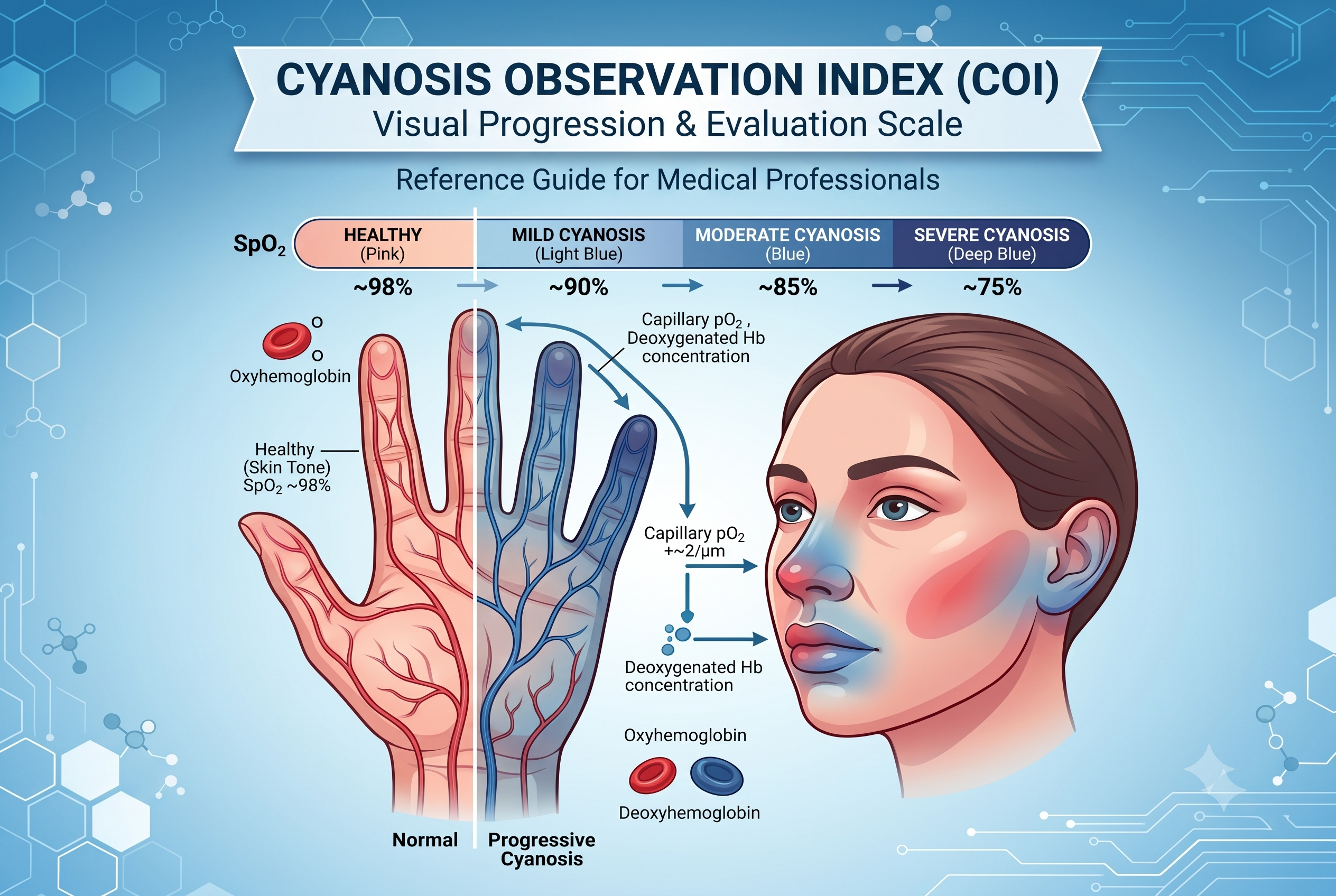
Cyanosis — the bluish discolouration of skin, lips, and nail beds caused by inadequate oxygen in the blood — is one of the earliest visual indicators of a patient in respiratory distress. For medical staff conducting routine ward rounds, the ability to detect cyanosis quickly and reliably can mean the difference between early intervention and a critical delay.
Yet the lighting under which these observations are made is often overlooked. As healthcare facilities transition from traditional incandescent or fluorescent sources to LED luminaires — particularly in bedhead lighting — a critical question arises:
Does your LED light source allow clinical staff to see cyanosis accurately?
The answer depends on a metric most lighting specifiers are unfamiliar with: the Cyanosis Observation Index (COI).
2. What Is COI?
The Cyanosis Observation Index is a quantitative measure of a light source’s ability to render skin colour accurately — specifically, its ability to reveal the bluish tint of cyanotic skin.
Unlike CRI (Colour Rendering Index), which evaluates colour fidelity across eight general colour samples (R1–R8), COI focuses exclusively on skin tone reproduction. It uses a specialised methodology:
- A test light source is compared against a reference illuminant (typically a Planckian radiator at 4000K).
- The colour difference (ΔE) is measured in CIE Lab colour space for both normal skin (ΔE_skin) and cyanotic skin (ΔE_cyan).
- The COI value is calculated as:
COI = (ΔE_skin + ΔE_cyan) / 2
A lower COI value indicates better performance — the light source renders skin colours more faithfully, making cyanosis easier to detect.
COI vs CRI — Why CRI Alone Is Not Enough
Parameter CRI (Ra) COI
Evaluates General colour Skin tone only
samples (R1-R8)
Colour space CIE 1931 (UVW) CIE Lab (perceptually uniform)
Reference Planckian/daylight 4000K Planckian
Healthcare value Good indicator Directly measures cyanosis
AS/NZS 1680.2.5 Ra ≥ 80 COI < 3.3
A light source can achieve a high CRI (Ra ≥ 90) yet still have a poor COI, because its spectral power distribution may have gaps or deficiencies in the wavelengths critical for skin tone rendering. This is particularly common in low-cost LED sources that use narrow-band phosphors.
3. Why LED Lighting Poses a Unique Challenge
Incandescent and halogen sources produce a continuous, full spectrum — closely resembling natural daylight. LED sources, by contrast, generate white light through a combination of a blue pump chip and one or more phosphor coatings. The resulting spectrum is not continuous; it has a pronounced blue peak and varies in how well it fills the red-deep-red region (630–700 nm).
This spectral characteristic directly impacts cyanosis detection. Haemoglobin, the oxygen-carrying protein in blood, undergoes a distinct colour change when deoxygenated:
- Oxygenated blood: bright red (higher reflectance in red wavelengths)
- Deoxygenated blood: darker, bluish-red (reduced reflectance in red wavelengths)
A light source with insufficient deep-red spectral content will compress this colour difference, making it harder for the human eye to distinguish between oxygenated and deoxygenated tissue.
4. The Regulatory Benchmark: AS/NZS 1680.2.5:2018
The Australian/New Zealand standard AS/NZS 1680.2.5:2018 — Interior and Workplace Lighting — Hospital and Medical Tasks is the first national standard globally to mandate a COI requirement. It specifies:
Parameter Requirement
COI < 3.3
CCT 3300K – 5300K
CRI (Ra) ≥ 80
Colour Fidelity (Rf) ≥ 80 (IES TM-30-15)
Skin Fidelity (Rf_skin) ≥ 90 (IES TM-30-15)
While AS/NZS 1680.2.5 is formally an Australian/New Zealand standard, its influence is growing internationally. Healthcare projects in the Middle East, Southeast Asia, and Europe are increasingly referencing it as best practice.
Key takeaway: If your healthcare project does not explicitly specify COI < 3.3, there is no guarantee that the installed lighting will support accurate cyanosis detection — regardless of CRI claims.
5. Beyond Compliance: How Leading Manufacturers Are Raising the Bar
Forward-thinking medical lighting manufacturers are now offering LED solutions that far exceed the minimum COI < 3.3 threshold.
Eagle Lighting Australia, for example, has introduced a CRI 95+ platform across its Operating Theatre, Cleanroom IP65, and Secureroom ranges. The key specifications:
Metric CRI 95+ Performance Industry Baseline
COI < 0.9 < 3.3
R9 (saturated red) 80+ Typically < 50
SDCM 2-step 3-5 step
Ra 95+ 80
Why this matters to specifiers:
- COI < 0.9 — Near-perfect cyanosis detection. The gap between normal and cyanotic skin is rendered with full fidelity.
- R9 > 80 — The deep-red component is dramatically stronger than standard LEDs. This improves skin tone rendering and supports red-light therapeutic applications.
- SDCM 2 — Tight colour consistency across the entire installation. Every fixture produces visually identical white light.
- Practical Guidance for Specifying Healthcare Lighting
6.1 Bedhead and Examination Lighting (COI-Critical Zones)
- COI ≤ 3.3 mandatory; COI ≤ 1.0 preferred
- Ra ≥ 90 (minimum)
- R9 ≥ 50 (minimum); R9 ≥ 80 (preferred)
- Rf_skin ≥ 90 (IES TM-30-15)
- SDCM ≤ 3 (preferably 2)
- CCT 4000K ± 300K
6.2 General Ward and Circulation Areas
- COI ≤ 3.3
- Ra ≥ 80
- CCT 4000K
- SDCM ≤ 3
6.3 Operating Theatres and Procedure Rooms
- COI ≤ 0.9 (best-in-class)
- Ra ≥ 95
- R9 ≥ 80
- SDCM ≤ 2
- CCT 4000K–5000K
6.4 Verification and Maintenance
- Require COI measurement reports from the luminaire manufacturer
- Specify IES LM-80 and TM-21 compliance
- Plan for periodic spectral verification — LED phosphors can shift with age
7. Frequently Asked Questions
Q: Does a high CRI guarantee a good COI?
A: No. CRI and COI measure different aspects. A source can have Ra > 90 yet score COI > 3.3.
Q: Is COI relevant outside of Australia and New Zealand?
A: Increasingly, yes. Healthcare projects in the UK, Middle East, and Asia are adopting it as a best-practice benchmark.
Q: Does COI apply to all products in a hospital?
A: COI is most critical in patient observation areas. Less critical in corridors and administrative zones.
Q: Can a luminaire’s COI degrade over time?
A: Yes. LED phosphor degradation can alter the spectrum. Insist on spectral stability data from the manufacturer.
8. Summary and Recommendations
Action Why
Specify COI < 3.3 in all patient areas Only metric for cyanosis detection
Request COI data from manufacturers Many products do not publish COI
Prefer COI ≤ 1.0 for critical zones CRI 95+ achieves this
Reference AS/NZS 1680.2.5:2018 Internationally recognised framework
Verify with spectral measurement Ensure installed performance
Plan for re-verification at year 3-5 Phosphor ageing may degrade COI
For more information on NBLITE’s medical-grade LED lighting solutions — including bedhead luminaires with certified COI < 1.0 performance — contact our specification team: sales@nblite.com
References:
- AS/NZS 1680.2.5:2018 — Interior and Workplace Lighting — Hospital and Medical Tasks
- CIE 13.3:1995 — Method of Measuring and Specifying Colour Rendering Properties
- IES TM-30-15 — Method for Evaluating Light Source Colour Rendition