

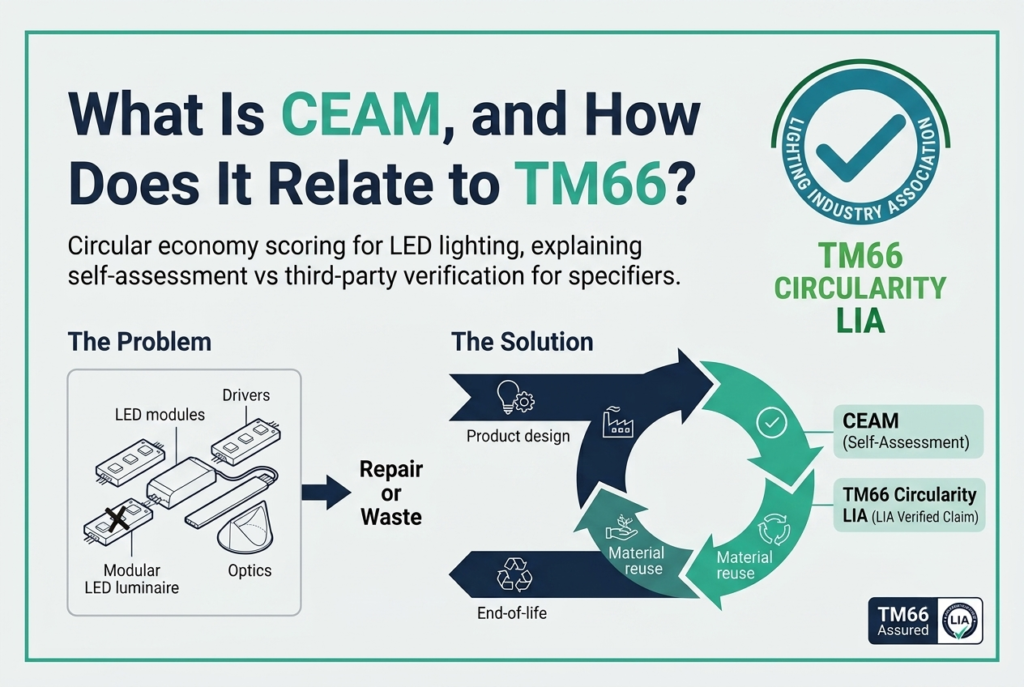
1. The Repair Problem LED Created
LED is efficient, long-lived and easy to control. Nobody disputes that. What gets less attention is what happened to the luminaire itself along the way: optics, drivers and LED engines are now brand- and product-specific, and often bonded rather than screwed together. A failed driver usually means scrapping the whole fixture, not swapping a part — expensive for the owner, and a waste of material that’s still functional.
CIBSE quantified this in Technical Memorandum TM66 (October 2021), built around a scoring tool called CEAM.
2. What CEAM Actually Measures
CEAM — Circular Economy Assessment Method — is the practical core of CIBSE TM66, published in October 2021. A manufacturer, or anyone else with the right product data, works through it to score a luminaire’s circular economy performance, so two products doing the same job can be compared on more than price and lumens per watt.
One thing worth being upfront about: CEAM is a self-assessment. It’s useful, but nobody checks it unless the manufacturer chooses to have it checked — which is what TM66 Assured is for (Section 6).
3. Two Tools, One Method
CIBSE publishes CEAM as two tools built on the same criteria, for two different audiences:
| CEAM-Make | CEAM-Specify | |
| Who uses it | Manufacturers, product design & sustainability teams | Specifiers, consultants, procurement teams |
| What it produces | A full, evidence-backed self-assessment across all four tabs | A quick side-by-side comparison of shortlisted products |
| Depth | Detailed — scored line items with supporting proof | Triage-level — headline scores only |
| Typical next step | Submit to the LIA for TM66 Assured | Shortlist, then request the full CEAM-Make record |
4. Four Tabs Make Up the Score
CEAM splits its questions across four tabs, and a product’s overall rating draws on all of them. Good materials alone won’t carry a weak manufacturing or ecosystem score.
| Area | What it covers |
| Product Design | Reusability of optics/accessories, light-source and driver upgradability, repairability, fixing method (screws vs. adhesive), service life, resilience to control-protocol obsolescence |
| Manufacturing Process | Supply-chain distance to assembly, supplier communication and training, closed-loop and additive/subtractive manufacturing waste, labour and CSR practices |
| Materials | Proportion of re-used and recycled content, identifiable plastics, bio-based/biodegradable materials, biodegradable packaging |
| Impact on Ecosystem | Reverse logistics and take-back, on-site upgrade or spot repair, access to photometry data after recovery, spare-parts commitment, warranty terms |
TM66 isn’t just the scoring sheet, either — the full document walks through supplier case studies (Stoane Lighting’s move to in-house aluminium recycling, Whitecroft’s cradle-to-cradle redesign of its Vitality range) that show what a high score looks like in practice.
5. Where Self-Assessment Falls Short
Two manufacturers can reasonably score similar products differently. “How reusable is the driver, really?” is a judgement call, and CEAM has dozens of them. A self-declared score tells you what a manufacturer believes about its own product, not what anyone independent has verified — and if you’re comparing suppliers, or trying to make a claim someone else will trust, that difference matters.
6. What TM66 Assured Actually Checks
TM66 Assured is the LIA’s (Lighting Industry Association) third-party assurance scheme for CEAM ratings, formalised in scheme document TSD-012 and run as an ISO/IEC 17067 type 1a certification. It doesn’t replace CEAM — it checks it.
The process starts with the manufacturer handing over a completed CEAM-Make record, supporting evidence (BOM, photos, supply-chain data) and a physical sample — chosen by the LIA, not picked by the applicant. Every answer across all four tabs then gets marked against the LIA’s own criteria, and clearing an average of 70% across all four is what it takes to pass.
Where the LIA’s marking lands on different from what the manufacturer claimed but the 70% line still holds, a certificate is issued at LIA’s revised rating instead. The client can appeal that or accept it; accepting comes with three months to update the rating wherever it’s used, in packaging, datasheets, wherever.
- Validity: Validity: three years, with review at renewal — or sooner if the design, materials or supply chain change significantly. The certificate holder must notify the LIA before applying such changes.
- The logo: the TM66 Assured / LIA Verified mark only goes on a product after certification — check any claim against the LIA’s public database at lialabcert.org.uk/certificates-search.
One caveat: Under TSD-012 v2.0, TM66 Circular Economy Assured is still a Beta programme, free to TM66 Founding Partners for a limited number of products. Outside that, cost is quoted case by case.
NBLITE designs its LED battens, panels, linear and downlight ranges around driver and light-engine formats that can be swapped rather than glued in — the kind of decision the CEAM Product Design tab is built to score. If you’re evaluating suppliers against TM66 or CEAM criteria for an OEM project or specification, our technical team can walk through our bill of materials and component sourcing directly: sales@nblite.com.
References
- CIBSE TM66: Creating a Circular Economy in the Lighting Industry (Society of Light and Lighting, October 2021).
- LIA TSD-012: TM66 Assured Product Verification Scheme, Version 2.0, October 2025.
- CIBSE Circular Economy Assessment Method — Make and Specify (TM66 digital tools).